Thursday, September 16, 2010

Hollywood calls again. You Pick Up The Phone. The Second Great Law of Hollywood Part 2


A month later the phone rings again.  This time from the Chelsea home of  Bigtime Financial Titan.

"Hello Bob?  Bigtime Financial Titan here.  Very good to talk to you, Bob.  Forgive me if I get straight to the point.  May I call you Bob?  Thank you Bob.  Bob, I just came back from the Grand Prix at Silverstone and, Bob, I was very impressed, Bob.  And Bob, I asked around for the best writer in Formula One and I was given your name.  Well I've read your book, Bob, and I just have one question for you.  How'd you like to make a movie of your book, Bob?

    "Depends, Bigtime" you say because you have learned hold back on the leap in until you know if it is a flaming pit or a black hole.

    "Call me Big.  Why don't you come down to my little place in Chelsea tomorrow, say at eleven Bob and we'll discuss it.  Is that all right Bob?  It won't take too long because I have a meeting with Rupert at two.  I do a lot of business with Mr. Murdoch.  See you at eleven then, Bob."

    You walk in his front door into a large open and airy room.  Tall palms rise from porcelain pots up to the two story high skylight and eight heads sitting around a conference table all turn to face you and they all say, "it's going to be a great movie, Bob"  There’s a famous ex-Formula One racing driver, a former Formula One team owner, a couple of assistant producers, a very glamorous lady who watches you like a hawk.  After small talk about big movies, a matched pair of limousines pull up to his front door and drive our party of ten sixty yards to lunch at a chic restaurant on The Kings Road.  We sit down at a round table.  Our host does not sit down but leans over the table, his hands on the back of my chair like a benevolent father.  And he says, "sorry I can't join you for lunch.  I've got a meeting with Murdoch. But after my meeting with Rupert I am going to draw up a company with you all on the board of directors to make this movie. Have a good lunch."

And you never ever see or hear from him again.

Which is the second great Law of Hollywood.  The first Law is from the great screenwriter William Goldman (who wrote Butch Cassidy and the Sundance Kid, Harper, All The President's Men, etc. etc.)  It goes:  Nobody ever knows anything.
 
The second great Law of Hollywood, if you haven't heard it before, comes from me and it goes: No answer means no.  And nobody ever knows why.

So six months later the phone rings again and a producer from New York has the money together, the director is hot to do it, wants you to write the screenplay and he wants to go straight into production as soon as he talks to your agent. Is that OK with you?

"Sure," you say.  "Yes, absolutely."

He never calls your agent. And you never ever hear from him again and you never know why.


(to be continued)

Wednesday, September 15, 2010

Hollywood calls, you pick up the phone: The Second Great Law of Hollywood


True story.

You come in the door in your house on Hampstead Heath in London and the phone is ringing and the voice has the authentic Hollywood rasp of sincerity and cocaine.

      "Hey man, I am so glad I caught you in I don't believe it.  I just flew in to LA, from this feature we're doing in Senegal.  Like Gorillas In the Mist only this is like Silverback's side of the story.  Anyway I was up all night reading your book on the plane,  Jesus, it is amazing, I mean I just could not put it down.  I mean forget dinner.  OK, First Class Virgin, dinner is not all that great, but you really caught it man, the whole scene, I mean I was there in the cockpit of a Formula One car turning left, the front end a little light, I mean fantastic.  Like I drove straight home to pick up the phone, like gotta call you.   Who you thinking of to play your guy, you know, the lead?  I"m thinking Cruise."

    The raspy voice pauses to suck in another lungful and you say, "Brad Pitt?"

    "Hey, what a great book, man.  I think we can get Julia for the female lead but listen Sandra Bullock's hot now and she owes me.  What a great book, man, I did a  Oceans I did Crash and this is gonna be bigger than all of that combined."

    You are thinking this is definitely not Soderberg.  Not Paul Haggis. You are thinking "did" could mean anything, like he saw them or went for coffee, but this is no time to interrupt.

    "Yeah, humongous.   Maybe the cars are the star, know what I mean?  Like we could tell the whole story from the car's point of view.  I'm just throwing that out.  Don't pay any attention if it don't ring bells.  So listen,  this is your baby and I don't want to screw around with options. I mean I don't want to be dicking around with the lawyers for the next six months  What I want is I want to go straight into production.  You got a script?"

    "Uh, not with me at the moment.  No."

    "Well I want you to do the script.  I'll work it out with your agent, what's his name. . .

    "Ralph Vincinanza."

    "Right, Ralph.  Bernie is gonna love this."

    "Bernie Ecclestone is gonna love this if you give him a piece of the gross."

    "Don't worry about Bernie.  I can handle him.  Listen, great talking to you, kid.  Start thinking about that script and I'll get back to you."

    And he hangs up and you never hear from him again.  And you will never know why.

(To be continued tomorrow)

Tuesday, September 14, 2010

Great Teachers #2: Jim Clark's Team Mate Peter Arundell

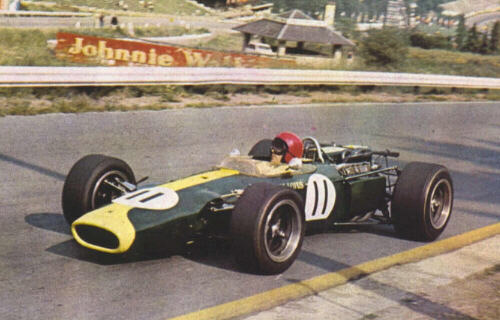
Peter Arundell in the Lotus 16 cylinder  BRM (credit: Autosport)
There's a scene in John Frankenheimer's movie Grand Prix when Scott Stoddard (played by Brian Bedford) after a long recovery from a ferocious crash, puts his crutches down and climbs slowly and painfully into his racing car. That would have to be Peter Arundel,  Jim Clark's Lotus F-1 team mate.
                  I was at Brands Hatch, going to racing driver school in the days when the instructors took you around the track in Lotus Elans.  There was a buzz among my fellow wannabe racers, "wow, that's Peter Arundel.  I didn't know he could walk."
                   He could barely walk.  He had crashed in a Formula 2 Race at Reims the year before, t-boned by Richie Ginther, smashing into a dirt bank and thrown out of his car.  He was at the very beginning of what looked like a brilliant career in Formula One.  But it took Arundell over a year to recover from a broken arm, thigh and collar bone, and a severe concussion.  In the meantime he was making ends meet by teaching mickey mouse drivers like me. 
                     He asked me to drive the Lotus around the race track, "take your time," he said, "I just want to see how you drive, not how fast you are."  So I did a couple of laps and he said, "would it be alright if I took the wheel for a bit?" 
                      I had never been in a car with a racing driver before.  Let alone a Formula One driver who had beaten Jim Clark.  The Lotus was transformed from a decent little car into a low flying object, engine screaming and tires squealing.  At some point the car became still and the race track came to us, fluid, rushing, as if we were sitting still and the landscape was rising and falling, tilting.  For a while I forgot to breathe.
                    I got back behind the wheel, and kindly, patiently Arundell showed me the braking points, where to turn in and how to take the car to its limits.  Or rather, my limits.  How to get on the brake pedal in a hurry, really use the brakes and lift off smoothly as we turned it.  He was patient, insightful.  From time to time, I thought I might be a racing driver.  (If you are not seriously delusional you will never be a racing driver.)
                      Arundell went back to Lotus in 1966, but he never made it back to the front of the grid.  Part of it seemed to be that he was driving  the clumsy, heavy and complex BRM H-16.  While Clark was driving the lighter, faster Cosworth V-8. But then Jimmy Clark qualified the H16 third on the grid at Monza while Peter was 13th in the Cosworth.  Clark won Watkins Glen in the BRM and Arundell finished last in the Cosworth. Chapman signed Graham Hill to partner Clark in 1967 and Arundell moved the the US to run a software company.


Monday, September 13, 2010

Bow Waves on the Road to Happiness. Our Honeymoon Barge.

Our little baby Toro coupe was alive and well and living in Florida


                Width was good.

                Length was even better.

                Yes, once upon a time size mattered in America and whoppers ruled the road.  In 1969 Easy Rider was at the drive-in, and Neil Armstrong was on the moon. ‘69 was Woodstock, LBJ’s last hurrah and Nixon’s inauguration. 1969 was the year  my 4,505 lb, 455 cu in, 375 hp. 510 lbs of torque, honeymoon barge was born.

1936 Cord
             The first generation Oldsmobile Toronado was the car of the year in ‘66.  Won Pikes Peak in ‘68 & ‘70. It was a technological breakthrough, a gentleman’s hot rod, a muscle car in a dinner jacket. It was the  first American, full-sized, front wheel drive car since the 1936 Cord. Indeed, its long nose, slotted wheels and disappearing headlights all pay homage to the Cord.

               “You bought a what?”   

                Well, it was late Friday night. I was just fooling around and, OK, things got out of control.  I threw a low ball bid on eBay and Sunday, when I came home from the weekend, the little two ton Toro was mine. 

              One wee snag. The car was retired and living in Miami.  Never mind we’ll have it trucked  to California in time to drive to Montana for the wedding and back.  It’ll be huge.


             Really huge. After decades of downsizing, it’s difficult to appreciate the  hugeness of American  cars when they had the roads to themselves.  A ‘69 Cadillac 75 sedan was over 20 ft long.  The Toro is 18 ft. long, a mere 4 inches short of a Suburban.  And the Toro is a coupe. A coupe  as huge as Asia. A coupe so heavy you can see a bow wave in the concrete as you roll down the highway.
 
               And look darling, there’s no hump on the floor, no lump in the middle for a transmission, no center console to prevent front seat canoodling.  Just wide open, immoral spaces.  According to the  FBI, center consoles were invented by hostile puritanical alien nations to bomb our birth rate and snuff out American teenage romance.  Yes, there’s  room to stretch out. Fool around. And the gear shift is on the steering column.  So four-on-the-floor would be consenting adults.  Plenty of room.  Oh, yes, Virginia size matters.

                 The day the car arrives, we snuggle in the back seat surrounded by an acre of blue vinyl.  Kathryn bursts into giggles.  “It’s like being a kid again.”

                 On our way to Montana for our wedding, we play a game when we come up on cars of lesser hulk.  When our front bumpers were even, a Ford Galaxie would come to the end the door.    (The doors are longer than most barns.) Lesser BMWs only reach the door lock button which is about half way down the door.  (‘66 & ‘67 Toros had two inside handles on the door.  One for back seat passengers, and one for folks up front.) Buckled in the front seat, a passenger  with less than Orangutang arms cannot reach the driver’s door handle.  Just too far away, my little rutabaga.

               We cruise the Nevada desert in our own baby blue living room. For all it size, it’s a peach to drive.  A setting sun outlines the car’s silhouette on the sand alongside the road.  We are two tiny heads inside a giant toy car rushing painlessly through cactus and mesquite.

             Now lets talk about hood length.  The Toro’s hood is longer than yours.  Longer than a Duesenberg’s.  The whole design flows back from the massive front end to emphasize the power up front. Oldsmobile designed and built their own engines, back then, with a high nickel content iron.  They pre-stretched the drive chain that transfers the power to the Hydramatic snuggled along-side the engine.  And built the car on it’s own assembly line.  The engineers wanted to be sure that there were no weak points in their revolutionary design.  Their aim was an American GT that would equal the best from Europe.  But on a larger, more American scale.  It was a time, as Joe Rusz wrote in Road & Track, “when every American felt he had the right to drive fast, kick ass and waste gas.”

               We swoop past a tiny Mercedes Fuel Cell Vehicle on a cross country run. A scientist and 4 journalists sit bolt upright inside, shoulder to shoulder.  They are the future: we are long gone.

              We reach Kathryn’s ranch in Montana (where she grew up on the river that runs through the movie) in one long zoom with a few hundred stops for gas plus one for a motel. Her old buddies tell me she was so wild and wooly climbing up and down the buffalo jump that she was 12 before they could tell her from the sheep.  It is also revealed, two days before the wedding, that ball joints would be required. 


             So the Toro missed the wedding.  Never mind.  Its role was to bring us home via a grand cruise through the mountains of Montana, Wyoming, Utah and Nevada.  And when the day came, the Toro was ready to roll.

Friday, September 10, 2010

My short happy war in Afghanistan


           On the way back home to NY City from London, my wife Karen drove our 2CV into a ditch just before the Czech border.  The car was scattered for 25 yards in the bottom of  the ditch with our luggage. It began to rain.
       We were headed back to America by way of Iran, India and Japan.  After a week of healing in a little railroad hotel in Amberg, Germany I took a train to Cologne and bought a lovely little used VW Karmann Ghia and we headed east for Istanbul, and Bombay.
The Blue Mosque in Herat, built 1200 AD


   It took two days to cross the border from Iran to Afghanistan.
The 2 lane black top built by America & Russia
Some of their guns were flintlocks
                     Driving into the sun out of Herat,  to Kandahar, two lane blacktop snaking across a vacuum of sand and lumps of  villages abandoned a thousand years ago, something. . .  Something black across the road.  Hard on the brakes, sliding back and forth to scrub off speed we bang a welded gate.  The windshield pops and a dozen men arise over a sand ridge in white robes waving rifles, screaming.  Ululating.  Surrounding us.  Pointing their guns at us.  “Our gate, our gate,” one of them yelled, “you have broken our gate. You must pay.”
           I was so pissed off.  If this were Afghanistan now, I would be terrified.
          But this was 1969.   “I didn’t break your fucking gate.”  The black steel bars of their gate was a mass of welds but it wasn’t broken.  “Your fucking gate broke my windshield.”
           “Your windshield is not broken.  We will help you put it back.”  And they did.
             We were driving from London  through Paris, Athens, and Istanbul on our way to India, and back home to New York.  I was a Creative Director at  JWT London.  A little like Don Draper with a corner office overlooking Berkeley, Square. They offered me a seat on the board.  and my wife said, “let’s take a trip around the world instead.”
              I thought that was a great idea. Still do. One day, maybe we’d be rich enough to go around the world in style.  But we’d be cranky old farts.  We were only 30, and this was the time to see what we could see.  We saw Teheran, drove over the Khyber Pass and down the length of India. Swam in the rainbow aquarium ocean in Ceylon, bicycled around the Angor Wat.
               When we got to San Francisco just before Christmas, the TV showed demonstrators in Phnom Penn chanting and waving posters, DOWN WITH SIHANOUK, GET THE REDS OUT OF CAMBODIA.  We had just been to Phnom Penh and in 1969 people spoke Khmer and/or French, but virtually  nobody there spoke or read English.